
Understanding The Skepticism
I will admit it: for a long time, I was pretty skeptical of annuities.
My experience was largely formed from the 401(k) side of the business. I would see annuities being pushed aggressively, often by insurance salespeople who seemed more focused on getting rollover dollars out of 401(k) plans than on solving a specific planning need. From where I sat, it often looked like a product sale first and a financial planning discussion second.
I also had a very practical question: why would someone take money that is already inside a tax-deferred account, like a 401(k) or IRA, and move it into another tax-deferred wrapper while potentially adding insurance charges, surrender schedules, and contract complexity?
At the time, that question made me pretty dismissive of the entire category.
Looking Beyond Product Preference
But over time, my view has changed.
I still believe annuities can be oversold. I still believe the costs, surrender charges, liquidity restrictions, and product details need to be carefully reviewed. And I still believe an annuity should never be purchased simply because someone likes the word “guarantee.”
But I no longer think the right question is whether someone is “for” or “against” annuities.
The better question is: what role, if any, should an annuity play inside the larger financial plan?
That distinction matters.
Annuities as a Planning Tool
An annuity is not automatically good or bad. It is a tool. And like any tool, its value depends on the job it is being asked to perform.
For some retirees, the primary planning concern is not maximizing every dollar of investment return. It is creating a reliable income stream they cannot outlive. They want to know that certain expenses will be covered regardless of what happens in the markets, how long they live, or whether the investment account balance eventually declines.
Where Guaranteed Income Can Add Value
In that context, guaranteed income can have real planning value.
It can provide a baseline of confidence. It can reduce the fear of running out of money. It can help a client separate their essential income needs from the portion of the portfolio that is designed for growth, flexibility, inflation protection, and legacy planning.
In some cases, it may even allow the client to be more comfortable taking appropriate investment risk with the rest of the portfolio. If a portion of retirement income is contractually guaranteed by an insurance carrier, the client may not feel the same pressure to make the entire portfolio act like a conservative income account.
That can be an important behavioral and planning benefit.
The Trade-Offs Still Matter
There is also the legacy conversation. Some annuity structures may allow income to be paid for life while still providing the opportunity for remaining value to pass to beneficiaries if the funds are not fully used. That does not mean every product accomplishes that goal equally well, but it does mean the discussion should be more nuanced than simply saying, “I like annuities” or “I hate annuities.”
Questions That Should Guide the Evaluation
The evaluation should be specific:
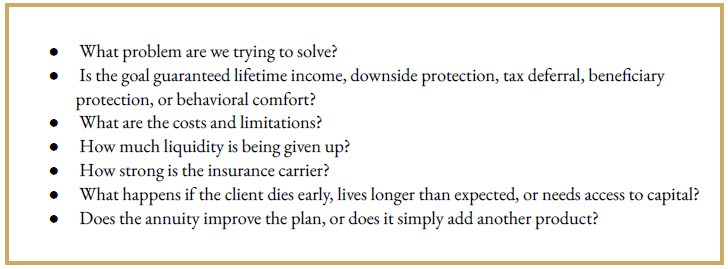
Those are the questions that matter.
The Better Approach: Be Pro-Plan
Being reflexively anti-annuity can cause an advisor to miss a useful planning tool. Being reflexively pro-annuity can lead to product-driven advice. Neither approach is ideal.
The better approach is to be pro-plan.
Annuities deserve neither blanket endorsement nor blanket criticism. They should be evaluated the same way any financial tool should be evaluated: by asking what role they play, what risk they are intended to address, what trade-offs they require, and whether those trade-offs are worth it for that specific client.
How Revant Evaluates Financial Tools
An annuity is not a financial plan. But in the right situation, it may play a valuable role inside one.
At Revant, this is the lens we bring to conversations around annuities and any other financial tool. The product is never the starting point. The plan is. Before any recommendation is made, the purpose has to be clear, the trade-offs have to be understood, and the strategy has to fit within the client’s broader financial life.
The product should serve the plan. The plan should never be built around the product.

This material is for general information and educational purposes only and is not intended to provide specific advice or recommendations for any individual. Investing involves risk including the loss of principal. There is no assurance that the views or strategies discussed are suitable for all investors or will yield positive outcomes.
Revant Wealth and LPL Financial do not provide legal advice or tax services. Please consult your legal advisor or tax advisor regarding your specific situation.
Annuities are long term, tax-deferred investment vehicles designed for retirement purposes and contain both an investment and insurance component. They have fees and charges, including mortality and expense risk charges, administrative fees, and contract fees. They are sold only by prospectus. Guarantees are based on the claims paying ability of the issuer. Withdrawals made prior to age 59 ½ are subject to 10% IRS penalty tax and surrender charges may apply. Gains from tax-deferred investments are taxable as ordinary income upon withdrawal. The investment returns and principal value of the available sub-account portfolios will fluctuate so that the value of an investor’s unit, when redeemed, may be worth more or less than their original value.